Overview
Trinity Christian School in Wanniassa, ACT, supports over 1,100 students from preschool to Year 12 on a single campus. As the school’s digital footprint expanded, it needed reliable infrastructure to manage a mixed fleet of shared and 1:1 devices.
Through its partnership with ASI Solutions, Trinity implemented Power Technologies charging systems and Clevertouch M series interactive displays to free up space, improve safety, and reduce IT administrative overhead.
The solution now supports flexible device access from early years through to middle school and has laid the foundation for future upgrades across the campus.

Challenge
Managing classroom devices had become increasingly complex for Trinity’s IT team. In the Junior School, iPads and 2-in-1s were shared among students, but older-style trolleys and power boards created safety concerns and were difficult to manage. For the Middle School’s 1:1 program, the school needed secure, in-class charging without cluttering floors or increasing risk.
The administrative load was also growing. Power boards and individual chargers required annual test and tag compliance, adding significantly to the IT team’s workload. Trinity needed solutions that were secure, space-efficient, and reduced time spent on compliance and maintenance.
Solution
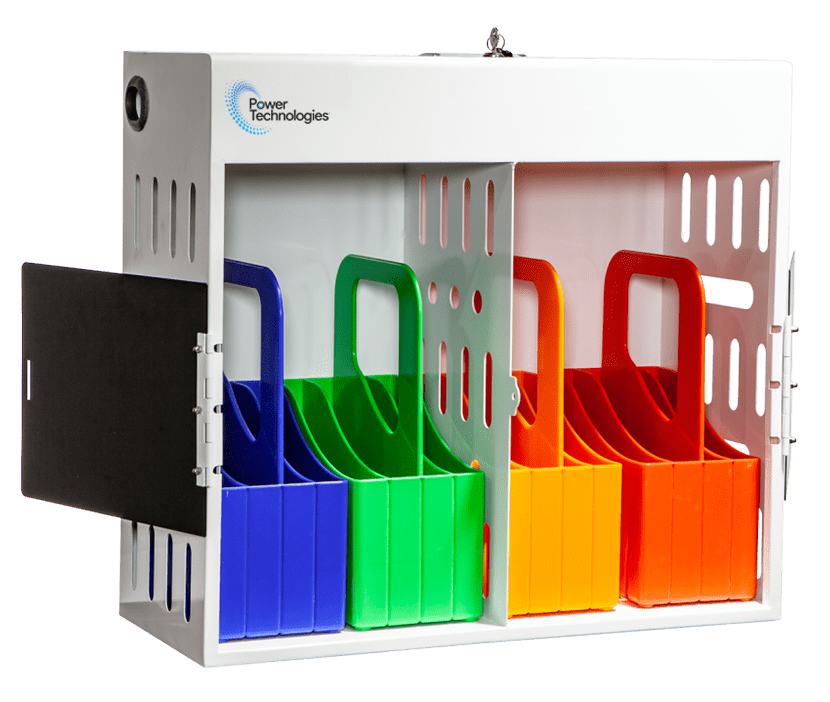
Trinity worked with ASI Solutions to implement purpose-built charging infrastructure tailored to different school stages. In the Junior School, wall-mounted Power Technologies AC-GO-16™ cabinets were installed to store and charge shared devices. Teachers can access and distribute devices easily using baskets of four, with cabinets positioned near key learning spaces like the library.
To complement shared learning spaces, Trinity added Clevertouch M series interactive displays. These panels are used for presentations and learning activities in the library and classrooms. With plug-and-play compatibility for Windows devices and full integration with Microsoft 365, they offer a simple upgrade without requiring additional staff training.
Results
The updated infrastructure has delivered clear improvements across the school. Junior classrooms are more organised, with compact wall cabinets replacing bulky trolleys. Teachers can access devices easily and safely, and students are no longer exposed to high-voltage power boards.
In the Middle School, charging trolleys provide a consistent and secure environment for 1:1 learning. Students can store and charge devices at school, removing pressure on home charging and keeping classrooms tidy and ready for learning.
Across both programs, the IT team now spends far less time on compliance, with fewer devices and power cords to manage. With more efficient logistics, safer spaces, and a consistent charging setup, the school has created a stronger foundation for digital learning.
Some of the key outcomes include: